
Hydrogen Tribology Testing
Hydrogen tribology testing: friction, wear and material compatibility of seals, bearings, coatings and lubricants in gaseous and liquid hydrogen, from −268 °C to 400 °C and from vacuum to 200 bar.
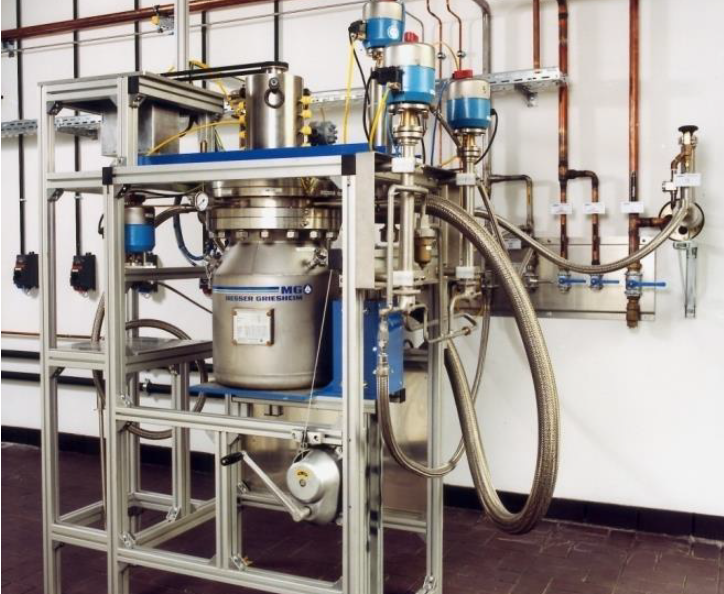


Why hydrogen changes friction and wear
- No oxide films. In dry hydrogen, metal surfaces stay clean and reactive, so adhesion, galling and transfer films behave very differently from tests in air.
- Oil-free operation. Compressors, valves and pumps for fuel-cell-grade hydrogen often run without lubricant, which puts self-lubricating polymers, carbon and coatings under heavy load.
- Hydrogen embrittlement. Hydrogen enters steel from the gas or from the lubricant breaking down in the contact. It reduces fatigue life and is discussed as one possible driver of white etching cracks in rolling bearings, whose root causes are still debated (Evans et al., Wear, 2013; Evans, Materials Science and Technology 32(11), 2016).
- Polymers and elastomers. Seals absorb hydrogen, swell, and can blister or tear when pressure drops quickly (rapid gas decompression).
- Cryogenic temperatures. In liquid hydrogen there is no conventional lubrication at all; polymers become stiff and brittle, and friction depends on the material pair alone.
Our hydrogen testing capacity
The European Tribology Centre gives you access to one of the widest ranges of hydrogen tribometers in Europe. We select the setup that best matches your application, plan the test programme and deliver one consistent report.
| Test setup | Media | Pressure | Motion | Load | Temperature |
|---|---|---|---|---|---|
| Oscillating (SRV-type) tribometer with real-time gas analysis | H₂, NH₃, CH₄, CO₂, N₂ | up to 10 bar | Linear oscillation, 0.01–5 mm, up to 100 Hz | up to 2000 N | −10 to 400 °C |
| High-pressure gas tribometer | H₂, CH₄, inert gases | up to 80 bar | Linear oscillation, 0.1–2 mm, 1–40 Hz | 5–20 N | 20 to 100 °C |
| Cryogenic tribometers | Liquid H₂, He, N₂, CH₄; gaseous H₂, CH₄, inert gases | 10⁻⁷ to 20 bar | Continuous rotation and rotary oscillation, 0.1–10 Hz | 5–1000 N | −268 to 20 °C |
| Tribologically induced hydrogen permeation (reciprocating tribometer + Devanathan–Stachurski cell) | Lubricated contact in air | 1 bar | Linear oscillation, up to 7 mm, up to 20 Hz | 50 N (up to 1 GPa) | 20 °C |
| Hydrogen pressure chamber | Gaseous H₂ | up to 200 bar | Static exposure | – | 20 to 80 °C |
What we measure
- Coefficient of friction, stick-slip and running-in, continuously during the test
- Wear rate and wear volume of both partners, measured by 3D surface topography
- Gas composition at the contact by quadrupole mass spectrometry (1–300 m/z), plus residual oxygen and contact temperature
- Hydrogen uptake of steel under sliding load, measured as an electrochemical permeation current
- Hydrogen solubility in lubricants and other fluids
- Damage after exposure: blistering and cracking (rapid gas decompression), swelling and embrittlement
Hydrogen test portfolio
Beyond the setups above, we organise the complete qualification programme for hydrogen service: friction and wear, material compatibility, component tests and analysis, to the standard your customer or regulator asks for.
Friction and wear in hydrogen
- Ball-, pin- and line-on-disc and reciprocating tests in gaseous hydrogen, natural gas–hydrogen blends and ammonia
- Sliding and rolling tests in liquid hydrogen, liquid helium and liquid nitrogen
- Benchmarking of self-lubricating polymers (PTFE, PEEK, PI compounds), carbon and DLC coatings for oil-free compressors and valves
- PFAS-free alternatives to PTFE-based seals and rider bands
Material compatibility with hydrogen
- Metals: steels for hydrogen gas cylinders (ISO 11114-4), tensile and notched tensile tests in high-pressure hydrogen (ASTM G142), fatigue crack growth rate in hydrogen (based on ASTM E647), hydrogen embrittlement caused by plating and coating processes (ASTM F519), hydrogen embrittlement threshold of steel by incremental step loading (ASTM F1624), thermal desorption analysis of hydrogen content
- Elastomers and polymers: rapid gas decompression (ISO 23936-2, NORSOK M-710), O-rings for hydrogen fuelling stations (ISO 19880-7), hydrogen permeation, swelling and ageing
Component and lubricant tests
- Reciprocating and rotary seals, valves and compressor piston rings
- Bearing materials for hydrogen service
- Piston ring and cylinder liner contacts for hydrogen combustion engines (H₂-ICE), including lubricant ageing by water and blow-by
- Greases and lubricants for hydrogen valves, pumps and bearings
Analysis after the test
Wear scars and surfaces are examined with 3D topography, SEM/EDX and chemical surface analysis, so you learn not only how much wear occurred but why. See Advanced Analytics.
Applications
- Refuelling stations and compressors: piston rings, rider bands, valve seats, dynamic seals
- Liquid hydrogen storage, transport and aerospace: cryogenic valves, pumps, bearings and seals
- Hydrogen engines and fuel cells: injectors, piston ring–liner contacts, recirculation blowers, lubricants
- Pipelines and gas grids with hydrogen blending: valves, seals, metals and polymers
Case study: sealing materials in liquid hydrogen
Test-Fuchs, an aerospace test-systems manufacturer, needed to choose sealing materials for new liquid-hydrogen valves. i-TRIBOMAT characterised and benchmarked the candidate materials directly in liquid hydrogen, giving the design team friction and wear data under the conditions the valves will actually see. Read more in our case studies.
One contact, the whole European network
i-TRIBOMAT is the single entry point to more than 130 tribometers and more than 250 experts across Europe. You do not need to find, compare and coordinate several laboratories: we do it for you.
- One contact and one offer for the whole programme, from screening tests to component qualification
- Independent choice of setup: we match your application to the right test, not to the equipment we happen to own
- One consistent report and, on request, your results in your own online database (see Data Driven Services)
- Confidentiality covered by a single agreement
Frequently asked questions
Can you test in liquid hydrogen?
Yes. Our cryogenic tribometers run in liquid hydrogen, liquid helium and liquid nitrogen down to −268 °C, with continuous rotation or rotary oscillation and loads up to 1000 N.
What hydrogen pressures can you test at?
Friction and wear tests run from vacuum up to 80 bar in gaseous hydrogen, and exposure tests up to 200 bar. If your application needs other conditions, tell us: we will propose the closest setup or a dedicated test.
Which standards do you work to?
Many hydrogen tribology tests are not standardised yet, so we design them to reproduce your application. For material compatibility we work to the standards your sector requires, such as ASTM G142, ISO 11114-4, ISO 23936-2 and NORSOK M-710.
Can you test my own components and materials?
Yes. We test coupons, coatings, polymers, lubricants and real components such as seals, rings and bearings. We agree specimen geometry and quantity with you before you ship.
How do I start?
Send us a short description of the application: medium, pressure, temperature, motion and the materials you want to compare. We reply with a test proposal and an offer.
Or write to office@i-tribomat.eu. See also all tribological characterisation services and our free Tribology Universe apps.