
Friction and Wear Testing
Friction and wear testing on tribometers that reproduce the contact and motion of your application: sliding, rolling, oscillating, fretting, abrasion and erosion, in air, liquids, vacuum or gases.
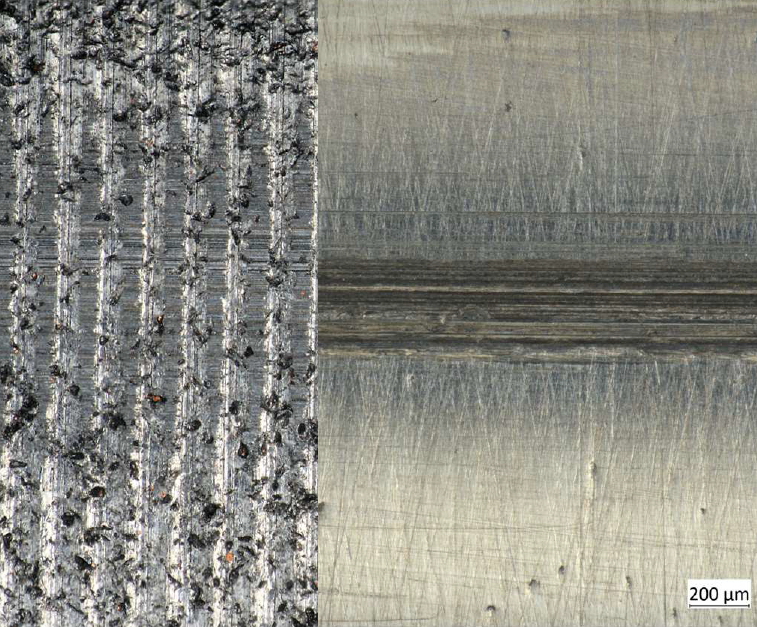


Choosing the right tribometer test
- Contact geometry: point (ball), line (cylinder) or area (flat, ring) contact.
- Motion: continuous sliding, reciprocating, oscillating, fretting, rolling with slip, impact.
- Environment: dry, lubricated, in corrosive liquids, in vacuum or gases, from cryogenic to high temperature.
- Load and speed matching the contact pressure and sliding speed of the application.
Tribometers in our network
Our network covers the main tribometer types. We select the one that best reproduces your application.
| Test setup | What it shows | Standard |
|---|---|---|
| Pin/ball-on-disc tribometers | Sliding friction and wear; versions for high temperature, vacuum, gases and cryogenic temperatures | ASTM G99 |
| Reciprocating tribometers | Friction and wear under linear reciprocating sliding, dry or lubricated | ASTM G133 |
| Oscillating (SRV-type) tribometers | High-frequency oscillation, including fretting | ASTM D7594 |
| Block-on-ring tribometers | Sliding wear of materials and lubricants | ASTM G77 |
| Twin-disc tribometers | Rolling with slip, as in gears, rail–wheel and cam contacts | – |
| Micro- and nanotribometers | Friction at very low forces (mN and µN) | – |
| Abrasion testers | Abrasive wear: dry sand/rubber wheel, abrasion of polymers, impact abrasion | ASTM G65 |
| Slurry erosion test rig | Erosion by particle-laden liquids | – |
| Tribocorrosion tribometers | Wear in corrosive liquids with electrochemical measurement | – |
| Thread friction and tapping torque testers | Friction of screw connections; performance of metalworking fluids in tapping | ISO 16047 |
| Hot strip sliding tribometer | Friction under hot forming conditions | – |
What we measure
- Coefficient of friction, recorded during the test
- Wear volume and wear rate of both partners, with 3D surface topography
- Wear mechanisms, with SEM/EDX
- Contact temperature and electrical contact resistance, depending on the setup
Key tribometer test standards
These are the methods most often used in this field. Where no standard fits your application, we propose a test closer to your operating conditions. Search all standards in our test standards finder.
Sliding: rotating and block-on-ring
| Standard | Test | What it measures |
|---|---|---|
| ASTM G99 | Pin-on-disk or ball-on-disk test | Sliding wear and friction coefficient |
| ISO 20808 | Ball-on-disc test of monolithic ceramics | Friction and specific wear rate of ceramics |
| ASTM G77 | Block-on-ring sliding wear | Ranking of materials by sliding wear |
| ASTM G137 | Block-on-ring sliding wear of plastics | Ranking of plastics by sliding wear |
| ASTM D2714 | Falex block-on-ring machine | Calibration and operation of the block-on-ring tester |
| ASTM D3702 | Thrust washer test | Wear rate and friction of self-lubricating materials |
Reciprocating, oscillating and fretting
| Standard | Test | What it measures |
|---|---|---|
| ASTM D7594 | SRV fretting wear test of greases | Fretting wear resistance at high Hertzian pressure |
| ASTM G133 | Linearly reciprocating ball-on-flat test | Sliding wear and friction under reciprocating motion |
| ASTM G181 | Piston ring and cylinder liner friction test | Lubricated friction of ring and liner materials |
| DIN 51834-3 | SRV test of materials with lubricants | Friction and wear of material pairs with a lubricant |
| ASTM D7755 | Wear volume on SRV test pieces | Wear scar volume by stylus profilometry |
| ASTM G204 | Damage under fretting conditions | Fretting damage from small-amplitude oscillating contact |
Adhesive wear and galling
| Standard | Test | What it measures |
|---|---|---|
| ASTM G223 | Twist compression test | Friction and adhesive wear under rotating, compressive contact |
| ASTM G98 | Galling resistance of materials | Threshold galling stress |
| ASTM G196 | Galling resistance of material couples | Galling resistance of material pairs |
Abrasion and erosion
| Standard | Test | What it measures |
|---|---|---|
| ASTM G65 | Dry sand / rubber wheel test | Low-stress three-body abrasion (volume loss) |
| ASTM G105 | Wet sand / rubber wheel test | Abrasion resistance in a wet sand slurry |
| ASTM B611 | High-stress abrasion of hard materials | Abrasion resistance of hard materials such as cemented carbides |
| ASTM G132 | Pin abrasion test | Two-body abrasion of a pin against abrasive paper |
| ASTM G76 | Solid particle erosion, gas jet | Erosion from a gas jet of solid particles |
| ASTM G32 | Vibratory cavitation erosion | Cavitation erosion rate |
| ASTM G73 | Liquid impingement erosion | Erosion from repeated liquid drop impacts |
Application-specific tests
| Standard | Test | What it measures |
|---|---|---|
| ISO 16047 | Torque/clamp force test of fasteners | Thread and under-head friction coefficients |
| EN 15427-2-1 | Railway flange lubricants | Properties and test methods of wheel flange lubricants |
| ASTM F732 | Wear of polymers for joint prostheses | Wear of implant polymers in pin-on-flat tests |
| VDA 230-206 | Stick-slip of material pairs | Stick-slip tendency of vehicle interior material pairs |
| EN 16165 | Slip resistance of pedestrian surfaces | Slip resistance of floors and walkways |
| ASTM G119 | Guide: synergism between wear and corrosion | How wear and corrosion together add to material loss |
Tests of specific components are on bearing testing, gear testing, seal testing and component testing; lubricant tests on lubricant testing; coatings on coating testing. Try also the free reciprocating friction test simulator and Hertzian contact pressure calculator on Tribology Universe.
References
- DEVA: benchmarking of self-lubricating bearing materials in vacuum
- CITRA: low-friction, low-wear thin films for high-temperature applications
- Klüber Lubrication: tribocorrosion behaviour of lubricants
Read the full statements in our case studies.
One contact, the whole European network
i-TRIBOMAT is the single entry point to more than 130 tribometers and more than 250 experts across Europe. You do not need to find, compare and coordinate several laboratories: we do it for you.
- One contact and one offer for the whole programme
- Independent choice of setup: we match your application to the right test, not to the equipment we happen to own
- One consistent report and, on request, your results in your own online database (see Data-Driven Services)
- Confidentiality covered by a single agreement
Frequently asked questions
Which tribometer test should I choose?
The one that reproduces your contact: geometry, motion, contact pressure, sliding speed, temperature and environment. Tell us about your application and we propose the test.
Can you test in vacuum, gases or at cryogenic temperatures?
Yes. Tribometers in our network run in vacuum, in nitrogen, hydrogen and methane, and at cryogenic temperatures down to −268 °C.
Do you measure wear of both partners?
Yes. Wear of the specimen and the counterpart is measured after the test, usually by 3D surface topography.
How do I start?
Send us a short description of the materials, the contact and the operating conditions, and the question you want answered. We reply with a test proposal and an offer.
Or write to office@i-tribomat.eu. See also all tribological characterisation services.