
Other Component Testing
Component testing of piston rings, brakes, clutches, slip rings and other machine elements, on component rigs or in model tests that reproduce their real contact conditions.


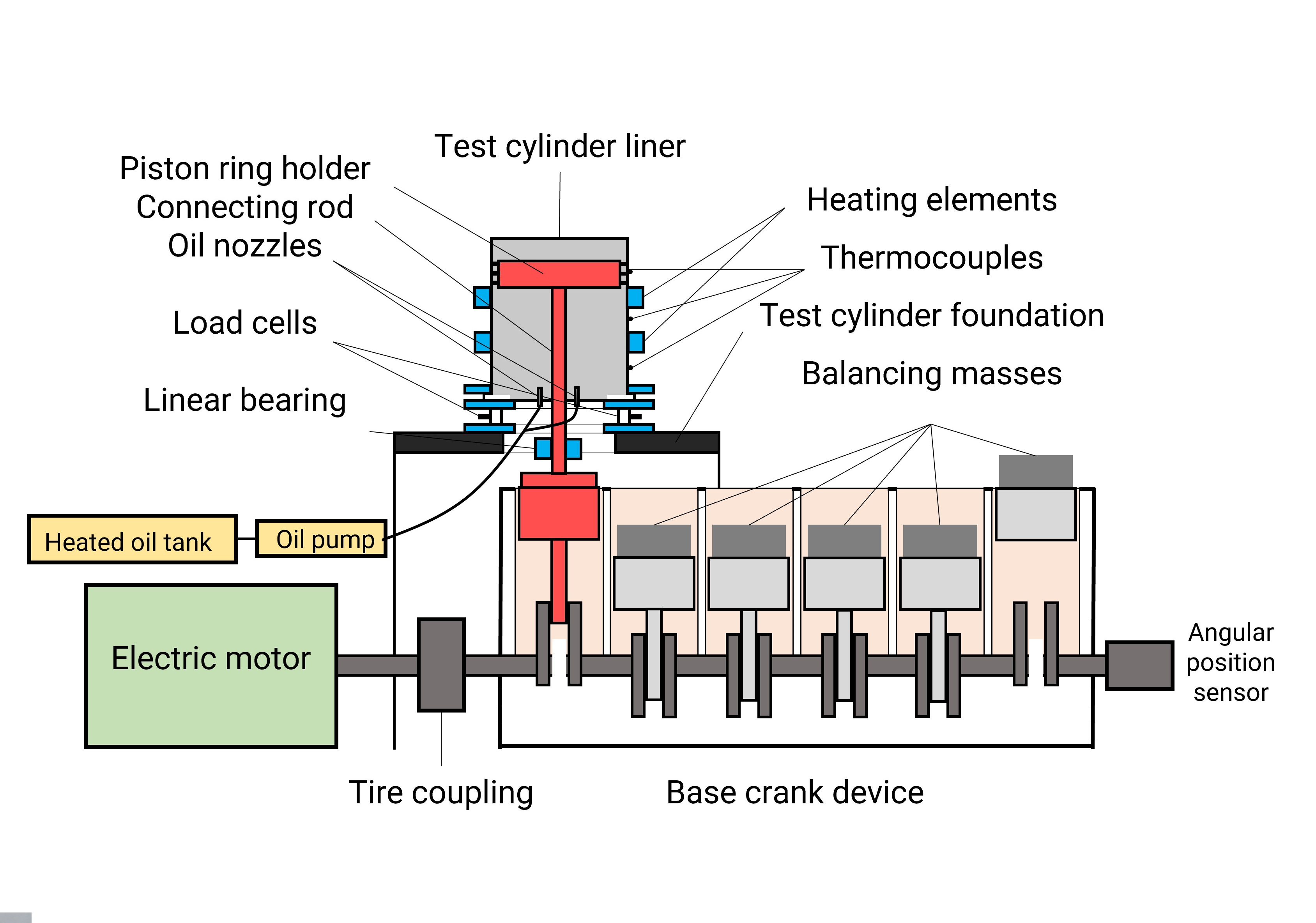
Component tests in our network
We choose the setup that matches your component. Bearings, gears and seals have their own pages: see bearing testing, gear testing and seal testing.
| Test setup | What it shows | Standard |
|---|---|---|
| Piston ring – cylinder liner tribometer | Friction of piston ring and cylinder liner in a full component setup | – |
| Brake tribometer (double pin-on-disc) | Friction and wear of brake material pairs | – |
| Wet clutch test rig | Friction and wear of wet clutch friction materials | – |
| Slip ring test rig | Slip rings and sliding electrical contacts under realistic operating conditions | – |
| Ring-on-ring friction rigs | Drive and friction elements with liquid media at different temperatures | – |
| Oscillating (SRV-type) tribometers | Model tests of brake fluids, synchronizers and other component contacts | DIN 51834-5, ASTM D8227 |
What we measure
- Friction, recorded during the test
- Wear of the component surfaces
- Temperature and, for electrical contacts, contact resistance
- Surfaces after the test, with 3D surface topography and SEM/EDX
Key component test standards
These are the methods most often used in this field. Where no standard fits your application, we propose a test closer to your operating conditions. Search all standards in our test standards finder.
Piston ring and cylinder liner
| Standard | Test | What it measures |
|---|---|---|
| ASTM G181 | Piston ring and cylinder liner friction test | Lubricated friction of ring and liner materials |
| ASTM G206 | Guide: wear volume of piston ring segments | Wear volume of ring segments tested against flat coupons |
Engine tests for lubricant qualification
| Standard | Test | What it measures |
|---|---|---|
| ASTM D8111 | Sequence IIIH | Oil thickening, piston deposits and ring sticking at high temperature |
| ASTM D6891 | Sequence IVA | Camshaft lobe wear |
| ASTM D8256 | Sequence VH | Low-temperature sludge and varnish |
| ASTM D8226 | Sequence VIF | Effect of engine oil on fuel economy |
| ASTM D8279 | Sequence X | Timing chain wear (elongation) |
| ASTM D7549 | Caterpillar C13 | Piston deposits, ring sticking and oil consumption |
| ASTM D5966 | Roller follower wear, light-duty diesel engine | Wear of roller follower axles |
| ASTM D7422 | Mack T-12 | Piston ring and liner wear and lead corrosion in an EGR diesel engine |
| ASTM D7484 | Cummins ISB | Valve train wear (crossheads and camshaft) |
Hydraulic pumps
| Standard | Test | What it measures |
|---|---|---|
| ISO 20763 | Vane pump test of hydraulic fluids | Anti-wear properties of hydraulic fluids |
| ASTM D7043 | Constant volume vane pump test | Pump wear with petroleum and non-petroleum hydraulic fluids |
| ASTM D6973 | High-pressure vane pump test | Pump wear with petroleum hydraulic fluids |
Transmissions and brakes
| Standard | Test | What it measures |
|---|---|---|
| ASTM D8227 | SRV synchronizer test | Friction of transmission fluids against synchronizer materials |
| ISO 4925 | Brake fluids | Specification and test methods for brake and clutch fluids |
| DIN 51834-5 | SRV brake fluid test | Friction-induced noise of brake fluids in an EPDM–metal contact |
| SAE J2522 | Inertia dynamometer brake effectiveness test | Friction coefficient of disc and drum brake materials |
| JASO T903 | Four-stroke motorcycle oil specification | Wet clutch friction of motorcycle engine oils |
Industries
- Automotive: engines, transmissions, clutches and brakes
- Railway: wheel–rail contact and flange lubrication
One contact, the whole European network
i-TRIBOMAT is the single entry point to more than 130 tribometers and more than 250 experts across Europe. You do not need to find, compare and coordinate several laboratories: we do it for you.
- One contact and one offer for the whole programme
- Independent choice of setup: we match your application to the right test, not to the equipment we happen to own
- One consistent report and, on request, your results in your own online database (see Data-Driven Services)
- Confidentiality covered by a single agreement
Frequently asked questions
Can you test my own component?
Often yes, depending on its size and the available rigs. Send us a drawing and your operating conditions and we will tell you which test is possible.
Component test or model test?
A model test on a tribometer is faster and cheaper and is good for ranking materials and lubricants. A component test confirms the result under real conditions. We often combine both.
How do I start?
Send us a short description of the component, the lubricant and the operating conditions, and the question you want answered. We reply with a test proposal and an offer.
Or write to office@i-tribomat.eu. See also all tribological characterisation services.